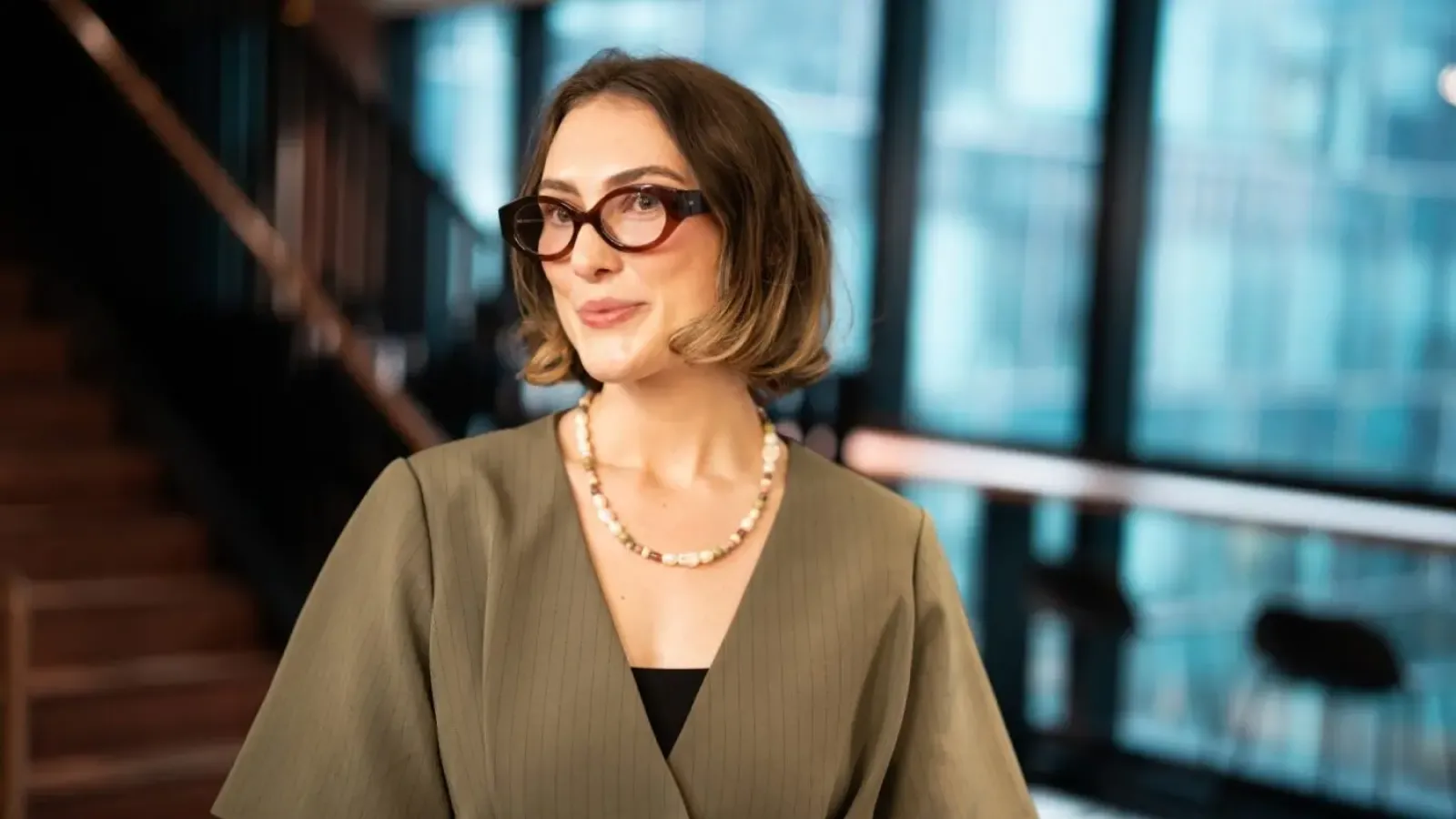
Dr Hannah Robertson recently completed her PhD with ANU POLIS: The Centre for Social Policy Research. Photo: Jack Ellis/ANU
75% of Australians who use dating apps have experienced some kind of harassment or abuse in digital dating contexts. New ANU research is helping shape the conversation around who should be held accountable.
Originally published on ANU Reporter. Written by Cecilia Millar-Rakisits
Whether we like it or not, finding love increasingly starts with a swipe.
For Dr Hannah Robertson, a researcher at POLIS: The Centre for Social Policy Research, understanding what happens next has become the focus of years of research.
Robertson explores how dating platforms shape experiences of safety, harm and accountability. Her work comes at a time when dating apps have become one of the most common ways people meet.
“Dating apps have reshaped modern relationships, but regulation has been a lot slower to catch up,” Robertson says.
As Australia rolls out a world-first Online Dating Code of Conduct for online dating services, we are beginning to see a shift from what users can do to protect themselves to what responsibility the platforms themselves should bear.
How dating apps have transformed relationships
Location-based dating apps were originally developed in 2009 for LGBTQIA+ communities, providing a space for people to connect at a time when broader society was less accepting. Initially, there was a stigma attached to these apps, particularly as they expanded beyond queer communities into heterosexual dating.
Today, however, online dating has become one of the most common ways for people to meet.
“We see research pointing to between 20 and 40 per cent of Australians meeting via dating platforms,” says Robertson.
However, dating apps are a double-edged sword. On the one hand, there’s the potential of connecting with someone, but the risk you take in the pursuit of finding a partner is now statistically putting you in harm’s way.
With dating apps creating new avenues for harassment, abuse and violence, a new question has emerged: when harm occurs, who should be held to account?
The accountability gap
For years, the question of responsibility has largely fallen on users themselves.
‘Be careful’, ‘meet in public’ and ‘trust your instincts’ are phrases many have heard when it comes to connecting with someone through a dating app. But according to Robertson, safety isn’t just about individual behaviour, it’s about the systems and platforms that shape those interactions.
“We’ve historically relied on a model of user responsibility,” says Robertson.
Dating platforms, much like social media companies, have traditionally operated under a model that places responsibility on users to manage their own safety. That responsibility is often reinforced in the fine print of terms of service agreements and community guidelines, which emphasise taking personal precautions.
Robertson advises that while users should continue to educate themselves, the accountability that platforms themselves must bear cannot be overlooked.
“It’s really critical that users are knowledgeable and empowered to make choices in an educated way. But there’s a delicate balance to strike because this victim-centric safety model can perpetuate victim-blaming rhetoric.”
That being said, the platforms themselves are not the only other player in this game.
Robertson says focusing solely on platforms risks overlooking the broader systems that shape people’s experiences, from police and courts to community attitudes and social norms.
How platform design shapes behaviour
While conversations about dating app safety continue to focus on users, Robertson says that the way these platforms are designed also plays an important role.
Platforms make design decisions that can impact trust, risk and behaviour.
“Platform design isn’t neutral. It influences behaviour, expectations and the kinds of interactions that become normalised,” says Robertson.
Features such as anonymous profiles, identity verification processes and reporting mechanisms can influence how a user experiences a platform. Anonymity, which was originally an important feature for LGBTQIA+ users exploring their identities, can be dangerous, allowing people to misrepresent themselves or avoid accountability for harmful behaviour.
“The question is no longer whether platforms have a role to play in preventing harm. It’s what meaningful accountability actually looks like.”
Robertson also flags the use of swipe-based matching systems, which have been criticised for encouraging users to make quick decisions based on limited, surface-level information.
These apps are designed, just like social-media apps, to maximise engagement, encouraging users to keep swiping through – what seems like – an endless pool of potential matches. While Hinge boasts the slogan “designed to be deleted”, the broader business model doesn’t always create incentives that align with users leaving the platform.
On these platforms, harm regulation often comes down to decisions about platform design, moderation and accountability.
“The question is no longer whether platforms have a role to play in preventing harm. It’s what meaningful accountability actually looks like.”
A world-first code
Australia introduced a world-first Voluntary Code for Online Dating Services in 2024, with the aim to improve safety standards and increase overall accountability for the industry.
For Robertson, the significance of the code extends beyond the measures it contains.
“The very existence of the code demonstrates a shift in public and government perception about who needs to be at the table when we’re discussing these harms and experiences, and who has a role to play in reducing the likelihood that a user is going to experience victimisation,” she says.
The code has attracted international attention, positioning Australia as a test case for whether industry-led regulation can meaningfully reduce harm.
“What’s really critical and significant about what this code represents more broadly, is that it’s a clear departure from the regulatory legacy that has characterised the industry and let companies do whatever they want, with no transparency and no consequences for their actions.”
Robertson cautions against viewing the code as a “silver bullet solution”. She acknowledges that safety on dating apps is not one-size-fits-all and cannot be addressed through platform regulation alone.
Ultimately, dating apps have fundamentally changed the way Australians meet, and they’re not going anywhere. For Robertson, the goal is not to discourage connection, but to make it safer, so Australians can continue to meet, connect and form relationships with confidence.


